Overview of her life
Ursula Kroeber Le Guin, who lived from 1929-2018, was an acclaimed author who wrote books for all ages, including 23 novels, 12 volumes of short stories, 11 volumes of poetry, 13 children’s books, five essay collections, and four works of translation. When writing fiction, her main genres were science-fiction and fantasy.
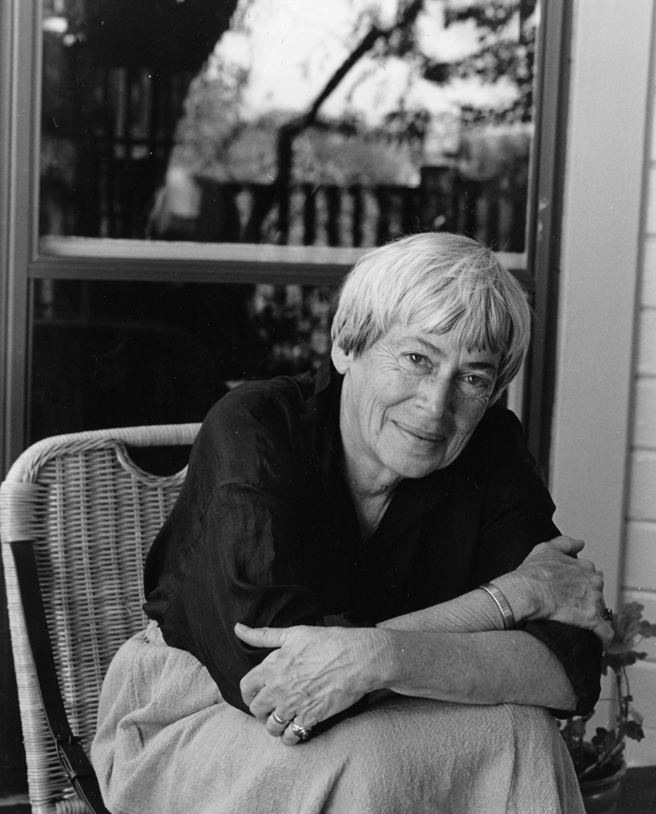
Her work and imagination led to many awards in her lifetime, including six Nebula awards and SFWA’s Grand Master award.
She is known by many as a creator of worlds due to the magnificent worlds she created in her sci-fi and fantasy novels.
When asked about her writing philosophy, Ursula said
“Writing is my craft. I honor it deeply. To have a craft, to be able to work at it, is to be honored by it.”
Her Early Years
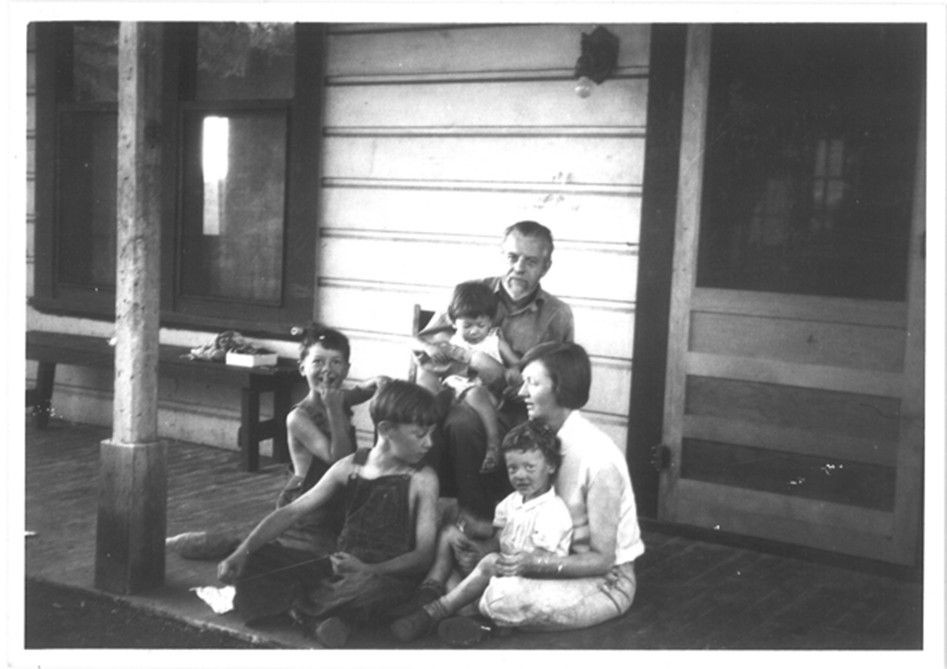
Ursula was born October 21,1929. Her father was anthropologist and professor Alfred Kroeber, and her mother was anthropologist and author Theodora Kroeber, who wrote the book Ishi- The Last of His Tribe.
Le Guin grew up in Berkeley, California with her parents and three brothers.
Living in a house full of books, music, storytelling, and discussion, Ursula has said that she “was brought up to think and to question and to enjoy.”
She also said that she grew up in a time when male supremacy was
“built firmly into every aspect of society and was very seldom challenged, but within her family she was never made to feel like less was expected of her than her brothers just because she was a girl.”
This world of male supremacy that dominated around her is later reflected in her work, where she writes firmly against male dominance.
Growing Up
Ursula’s father was a university professor, so even in the Depression in the 1930s, her family was well off, living in a redwood house in Berkley, and spending summers on a ranch in Napa Valley.
Ursula’s family neither encouraged nor was against her writing. At the age of nine, Ursula wrote her first story. It was about a man who saw elves. Nobody else can see him, and they get him in the end. It was a bleak story, but her first.
During World War 2, her brothers all went to service, and her summers in the valley became lonely, with just her and her parents turning on the radio to get war news. She says that those
“summers of solitutde and silence, a teenager wandering the hills onmy own, no company, nothing to do, were very important to me. I think I started making my soul then.”
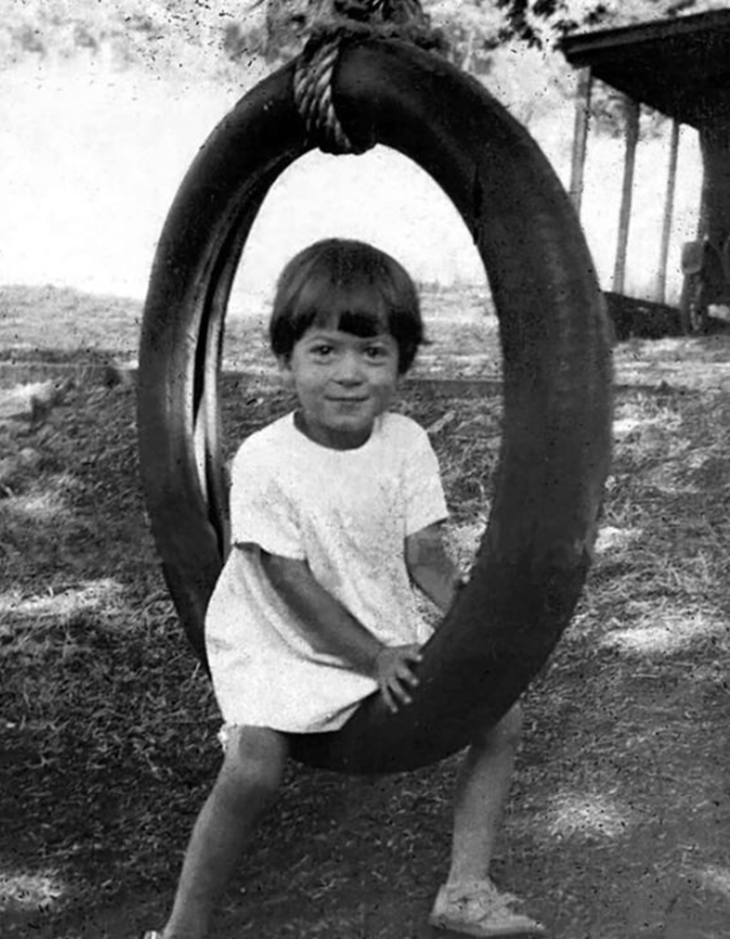
When asked about this statement in an interview by Bridget Huber in 2013, Ursula reminisces on the fact that solitude was an option in her time. Today, children are burdened with the world of social media, the need to constantly stay present. But Ursula says,
“it’s important there also be an option not to be in touch for a while, to just drop out. How do you know who you are if you’re always with other people doing what they do?”
Adulthood and Career
Ursula attended Radcliffe College.
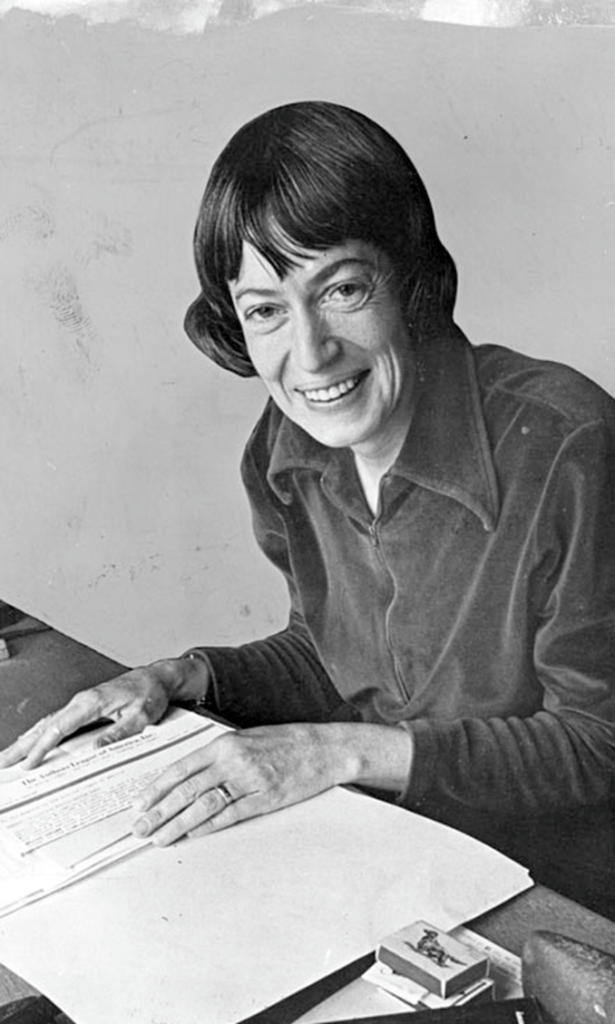
She later says of the college,
“The woman’s college I more or less accidentally went to, Radcliffe, though a mere thorn in the giant manly flesh of Harvard, taught me what women as a group could do and be, when not shamed and badgered and crowded out of it.”
After completing schooling at Radcliffe, she went on to get her Masters at Columbia University.
While pursuing a doctorate in French and Italian renaissance literature, she met another Fullbright fellow, historian Charles A Le Guin, and they married a few months later in Paris in 1953.
In 1958, they moved to Oregon to start their careers and family. Her and Charles went on to have three children and four grandchildren.
On January 22, 2018, Ursula passed away at her home.
Notable Works- Books of Earhsea
Perhaps her most famous book was the first of her Earthsea series, A Wizard of Earthsea.
Her book was much more than just dragons and magic. A Wizard of Earthsea, published in 1968, is about the fictional place Earthsea, and young wizard, Ged, who becomes too reckless in his quest for knowledge and power. He accidentally unleashes a terrible shadow, and he must figure out how to master the power and restore balance on Earthsea.
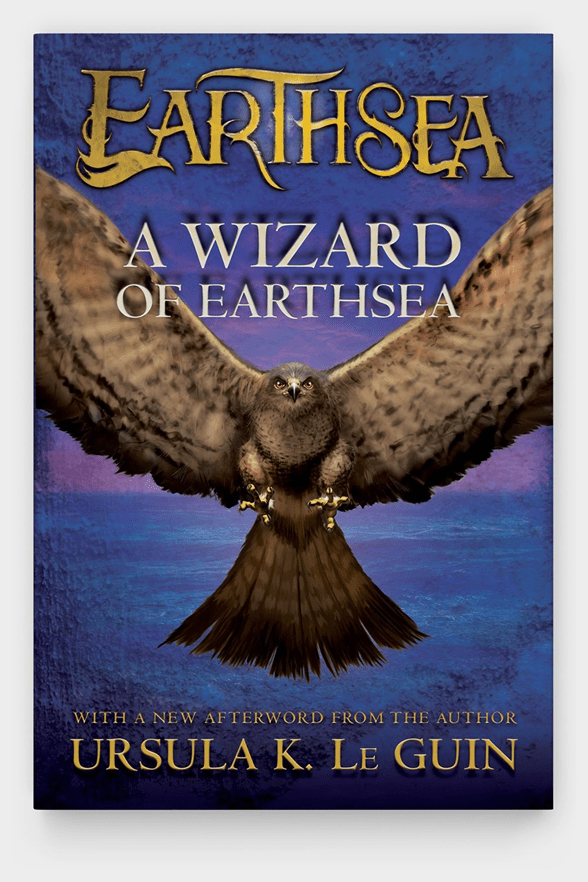
“A Wizard of Earthsea is one of the most beautifully written books in the English language. It’s also one of the very few fantasy novels that succeeds in feeling like a legend.”
-Tor
This influntial book was only the start to the Earthsea books.
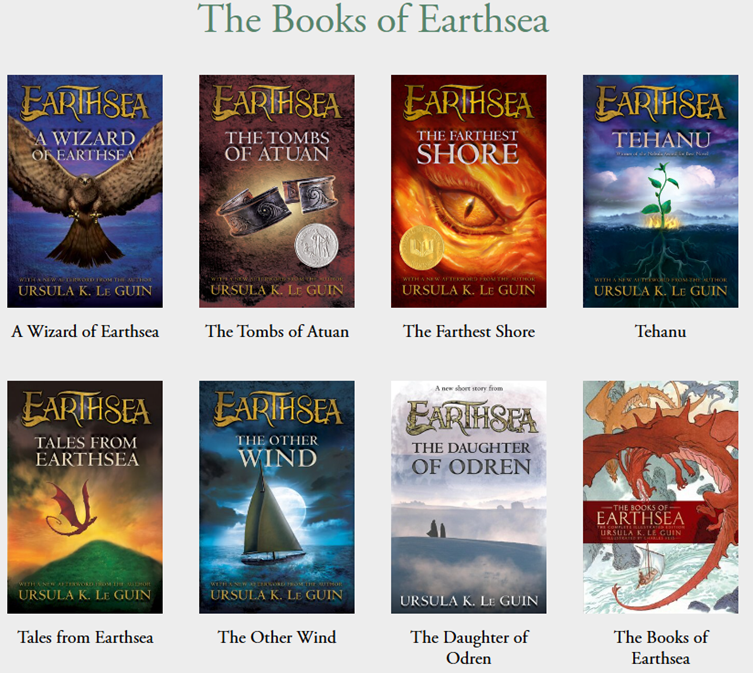
After publishing ‘A Wizard of Earthsea’, Ursula went on to publish 5 more books in the series, with the full series being published between 1968 and 2001.
She initially wrote two more to make a trilogy
The Tombs of Atuan was the second book. Published in 1971, this book focuses on high priestess Tenar and her interaction with wizard Ged Sparrowhawk from the first book.
The third book, published in 1972, was The Farthest Shore. This focuses on darkness overtaking Earthsea and what Ged Sparrowhawk is determined to do to prevent devastating loss.
The series was thought to be over but continued again in 1990 with Tehanu. Between the third novel and this one getting published, Le Guin focused her skills to be in line with her feminism, to make sure that the protagonist of this book, once again high priestess Tenar, would be a stronger written woman than in the previous books.
The fifth book of the series was Tales from Earthsea. Published in 2001, this contains the novella ‘The Finder’ and four short stories.
Last in the series, also in 2001, was The Other Wind, with a conclusion to wrap up all the intertwined stories.
There is also a stand-alone ebook, The Daughter of Odren, which was published in 2014. though it is not technically part of the series, it does take place on Earthsea.
This magical series has stood the test of time, continually being republished in new editions, such as The books of Earthsea collection shown in the picture above.
“The Earthsea saga, begun in 1968 as a young adults’ series, has evolved into one of le guin’s, and modern science fiction’s, signature achievements.” -Gerald Jonas, The New York Times
Notable works: Catwings
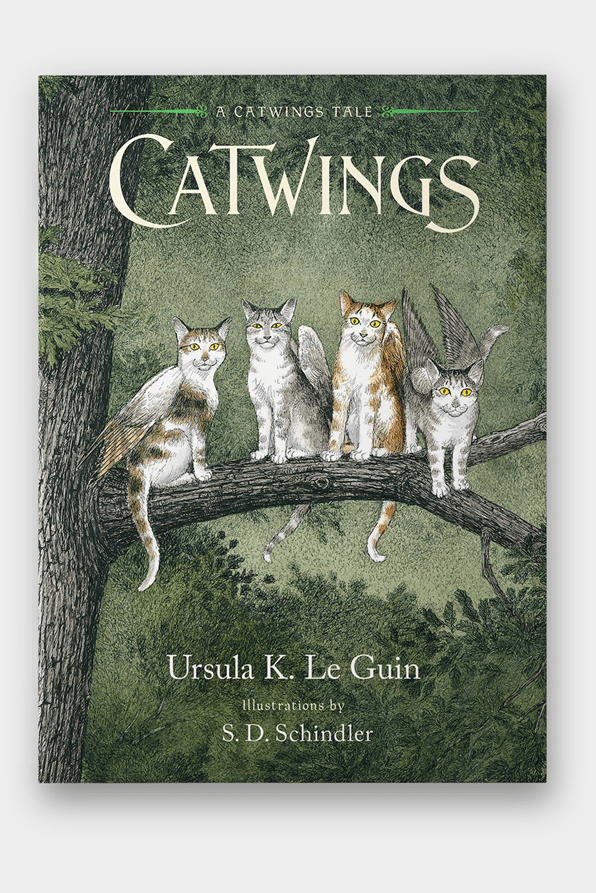
One of her other notable children’s series was Catwings
The first of the Catwings series, also titled Catwings, was published in 1988. This book is about Mrs. Jane Tabby, who cannot explain why her four kittens were born with wings, yet she is grateful that they can fly away from the city slums in which they were born. Once the kittens manage to escape the city, they learn that country life can be just as difficult.
“I realy liked Catwings alot and I hope you will write more about them. I drew a picture of a Catwing.”
—Josh B, age 8, Detroit
Lucky for Josh, the series did continue.
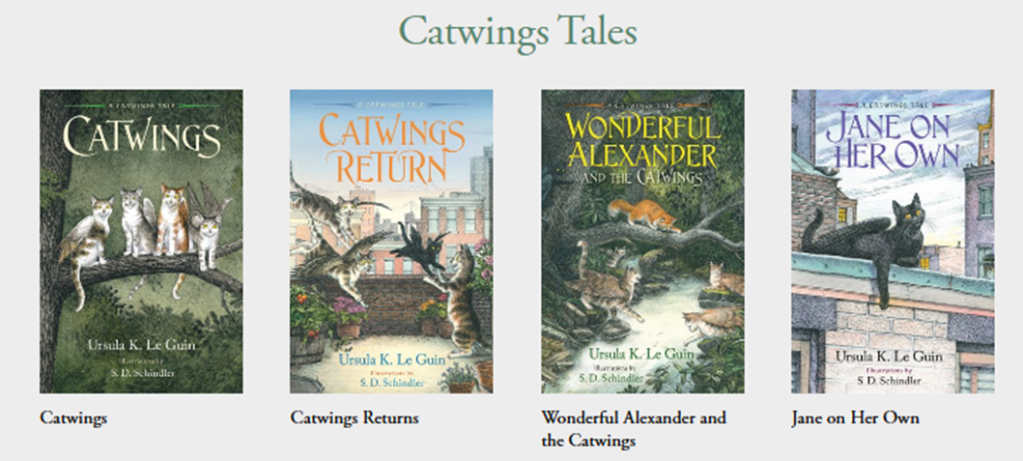
There were three more books in the series detailing the cats’ adventures.
From Author Michael Chabon. “In the hadns of a great artist, what we call fantasy and science fiction are best understood not as literary genres so much as literature in its pureset form: the calling into existence, by means of the enchantments of language fueled by the mana of imagination, of worlds and communities.”
Book two, titled Catwings Returns, was published in 1989. This book focuses on the cats returning to the city to visit their mother.
Book three, titled Wonderful Alexander and the Catwings, was published in 1994. This book focuses on Alexander the cat, who was rescued by one of the Catwings.
The fourth and final book, titled Jane on Her Own, was published in 1999. This one is about the youngest of the catwings, Jane, who must plan an escape after becoming captured by a man in the city.
These four books captured the hearts of many.
“Le Guin’s four catwings books make a gentle, warm space to stretch one’s literary wings, with an eye to injustice, written in her sonorous sentences.”
—Bookriot
Other Notable Works
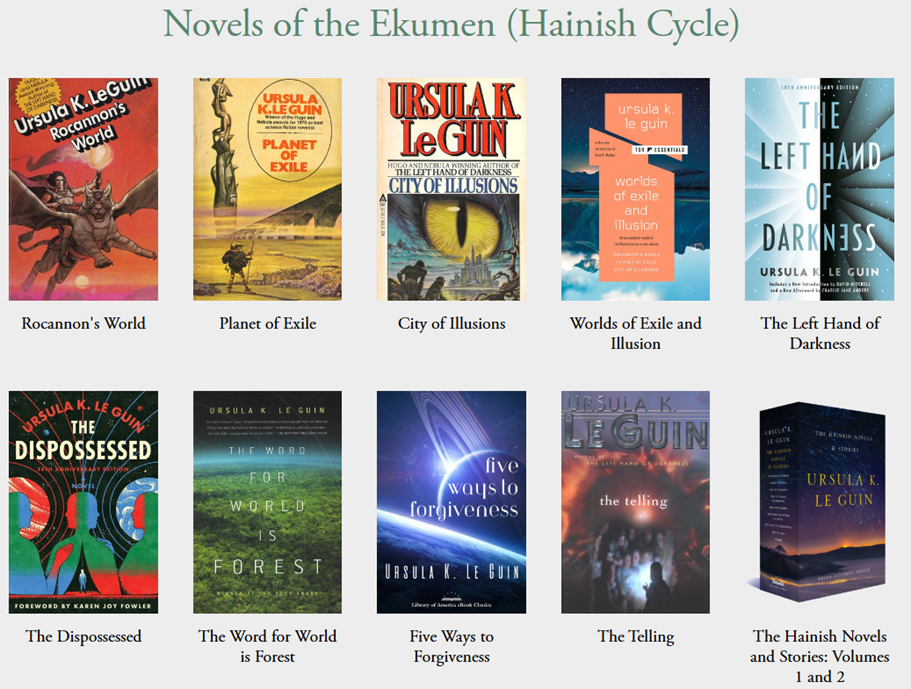
These titles don’t seem to have strict reading levels that I can find, but they seem to range from young adult to adult level. The picture to the side contains some of her most notable and awarded books.
Her first published novel, in 1966, was Rocannons World. This is about earth-scientist Rocannon who is on a survey on a remote world populated by three races. When the planet is invaded and raocannon is left alone among the alien peoples, he leads the battle to free this new world.
Her book The Left Hand of Darkness has won both a nebula and a hugo award.
Her book The Dispossessed, often cited in articles about le guin’s contributions to the genre, has won Nebula, Hugo, Locus, and Jupiter awards.
Awards
Those awards are not the only ones she has been awarded. She has received: 8 Hugo awards, 6 nebula awards, 3 world fantasy awards, and 26 locus awards.
Special awards include being inducted into the science fiction hall of fame in 2011, the Science fiction and fantasy writers (SFWA grand master award in 2003, world fantasy award for life achievement in 1995.
In her acceptance speech of the National Book Foundation Medal for Distinguished contribution to American letters in 2014, Ursula spoke about resistance.
“Books aren’t just commodities; the profit motive is often in conflict with the aims of art. We live in capitalism, its power seems inescapable – but then, so did the divine right of kings, any human power can be resisted and changed by human beings. Resistance and change often begin in art. Very often in our art, the art of words.”
Critical Responses
There are many responses to Ursula and her work. Here are a few that I have found the most thought-provoking or that show the most depth into her philosophy.
Biographer and author Julie Phillips wrote, “Le Guin began publishing science fiction in the early 1960s and within ten years was acknowledged as one of the most important writers in the genre… When she found her way into science fiction and fantasy, those genres turned out to be well suited to her imagination, her curiosity, and her subversive suspicion that man was not the measure of all things.”
Last here, Author Elaine Showalter talks about Ursula giving the commencement address at Bryn Mawr college in 1986. There, she spoke about the distinction between the father tongue and mother tongue. The father tongue, the language of power and reason all women who wanted a public voice had to speak, and mother tonue, the language of stories, converstion, and relationship. And compared women to volcanoes, imploring them to erupt, speaking our experiences as truth, saying “if we don’t tell our truth who will? Elaine Showalter ends her article with the above quote, saying that le guin set the pace as a writer for women unlearning silence, fear and self doubt.” I found this to be a powerful read.
Feminism, gender, and philosophy
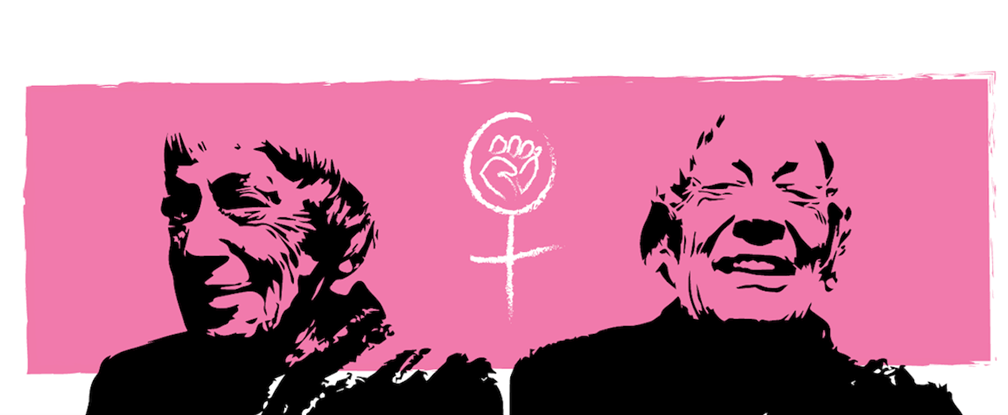
Many of Le Guin’s books focus on the discourse of gender and sexuality. (Yerber 2020). At her time of death, she was an acclaimed feminist, but her writings didn’t always show this.
“When I started writing, the easiest thing for a woman to do was in a sense to be an honorary man, to pretend she was a man, to put men at the center of the story, which does seem to be very important to men.
But this strikes me as kind of sad and probably not necessary because I think that most men and women have both men and women inside them. Lots of them are capable of being much more than they are told they are capable of being. So when I realized finally, thanks to feminists… I sort of had to sit down and say well, “Ain’t I a woman?” and if I am a woman why am I writing as a man?
Ursula herself says that her much-loved Earthsea books are a total complete bust as feminist literature, and it wasn’t until later in her career that she was able to tell stories from a women’s perspective in the way she desired,
“In both The Tombs of Atuan and Tehanu, books in which women are central to the story, there’s a kind of anger which I don’t think is in A Wizard or The Farthest Shore. It’s the anger of the underdog, fury against social injustice, the vengeful rage women have too often been made to feel. I’d finally learned to acknowledge such anger in myself and try to express it without injustice”(dintino 2020)
Ursula talked often in interviews about her becoming a feminist, as it was a popular question. She attributes some of it to her mother and great aunt. Though they did not call themselves feminists, they were both very strong independent women, which led to Ursula growing up with a similar feeling. Ursula says she became a feminist in the 1970s, she says, “it was a real mind shift. And I was a grown woman with kids. And mothers of children were not welcome among a lot of early feminists…it took a lot of thinking for me to find what kind of feminist I could be and why I wanted to be a feminist.
Another feminist issue she talked about in an interview was pronouns, and how she went about pronouns with one of her androdgenous characters. She acknowleged the need for ‘singular they’ to be restored in writing, instead of the default he/his when gender is unknown. (Yerber, 2020)
Style
Her style encompasses more than the feminism undertones. Her works were masterpieces, works of thematic, stylistic, structural, conceptual, and psychological sophistication and depth, intricately patterned, vividly imagined, intensely felt, beautifully written.
She did not stray beyond boundaries of genre, but rather, she expanded them (Chabon, 2019).
She did not make her style fit the norms, resisting the approach that emphasized having a hero, a conflict, and a storyline, asking why should it only move in one direction? (Phillips)
Another main thing that impacted her style was her Taoism. This theme runs through many of her fiction novels.
The Ursula K Le Guin Prize for Fiction
One last thing I want to touch on is the Ursula K Le Guin prize for fiction. This prize is an annual $25000 cash prize given to a writer for a single work of imaginative fiction. It is intended to recognize realists of a larger reality, who can imagine real grounds for hope and see alternatives to how we live now
Her son Gheo has said “Many will appreciate the irony in that Ursula herself was suspicious of literary awards and prizes. At the same time, she recognized their genuine value in honoring a writer and increasing visibility of good, undervalued writing. She also knew that a bit of money, at the right moment and in the right spirit, can be a turning point in a writer’s ability to continue writing. I hope the Prize will provide meaningful help and recognition to writers who might otherwise not receive it.”
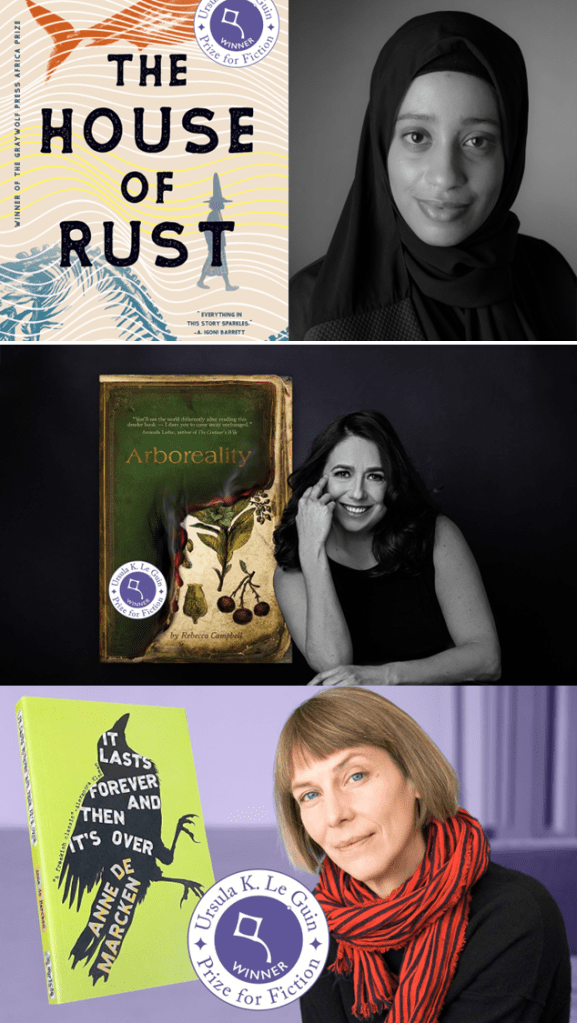
This prize was established in 2022. Anyone is free to nominate full-length English books, and winners are chosen by a panel. There have been 3 winners to date, which are on the right of the slide.
The 2022 winner was Khadija Abdalla Bajabar for The House of Rust, published by Graywolf Press. Young Aisha sets out in the company of a talking cat and a aboat of bones to rescue her father. The world she has written explores leviathans, snake gods, and crows who watch over all. She was chosen for the award because the panel found her writing to be cinematic, mapping a land between harsh reality, fantasy, and folklore.
The 2023 winner was Rebecca Campbell for Arboreality, published by Stelliform press. This book links stories through generations, exploring the effects of climate change on British Columbia. This was chosen for the award because it explores difficulties of our project of survival on earth, imagining what we haven’t yet considered could go wrong.
The most recent winner in 2024 was Anne de Marcken for It Lasts Forever and Then its Done, published by new directions publishing. This book about a shattered world was chosen because it is a poignant story about the afterlives of memory and disorienting space where our pasts go to disintegrate.
These three winners all embody what Ursula advocated for, “voices of writers who can see through our fear-stricken society to other ways of being.:
Conclsuion
Ursula K. Le Guin was an influential author, with notable works that have stood the test of time. Her books continue to be popular after her death, for good reason.
When asked what she wanted her legacy to be, so said “Irreverence toward undeserved authority, and passionate respect for the power of the word.” Through all my research, she seems to have accomplished that very thing.
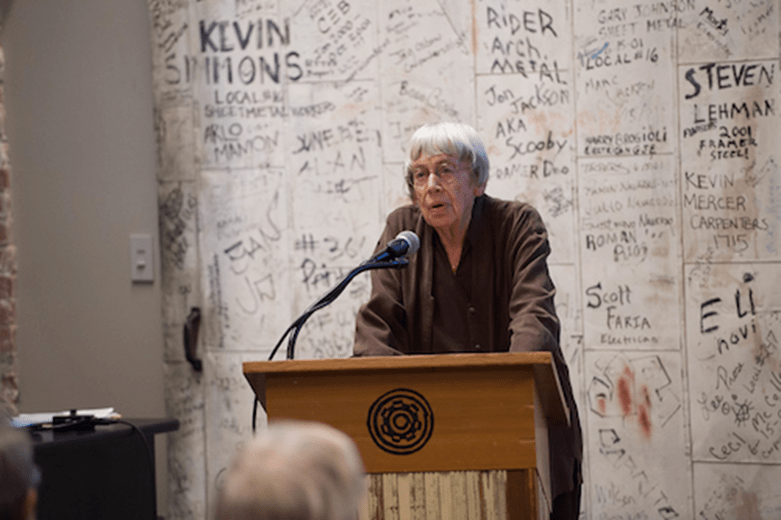
This irreverence is shown in the quote on the right, which is from her book No time to spare- thinking about what matters. She talks about how defenders of status quo may denigrate imaginative literature, and that literature is a resistance to oppression.
All the work she did for sci-fi and fantasy lives on in her many novels, the words in her books being quoted to this day. Her work as a feminist will also be remembered for years to come.
References
Chabon, M. (2019, November 20). Le guin’s subversive imagination. The Paris Review. https://www.theparisreview.org/blog/2019/11/20/leguins-subversive-imagination/
Dintino, T. C. (2020, August 25). How woman writer Ursula K. Le Guin got her feminist groove on. Nasty Women Writers. https://www.nastywomenwriters.com/how-ursula-k-le-guin-got-her-feminist-groove-on/
Galadhorn. (2019, August 21). Ursula K. Le Guin’s roots in Poland! https://tolkniety.blogspot.com/2019/08/ursula-k-le-guins-roots-in-poland.html
Glass, M. (2022, June 30). Ursula K. Le Guin (1929–2018). The Oregon Encyclopedia. https://www.oregonencyclopedia.org/articles/le_guin_ursula_1929_/
Goodreads. (n.d.). No time to spare quotes by Ursula K. Le Guin. Goodreads. https://www.goodreads.com/work/quotes/54264477-no-time-to-spare-thinking-about-what-matters
Kelly, M. R. (2024). Ursula K. Le Guin. sfadb. https://www.sfadb.com/Ursula_K_Le_Guin
Le Guin, U. K. Streitfeld, D. (2019). Ursula K. Le Guin: The last interview: and other conversations. Melville House Publishing. 9781612197807.
Library of America. (2022, January 5). Fellow writers remember Ursula K. Le Guin, 1929–2018. https://www.loa.org/news-and-views/1375-fellow-writers-remember-ursula-k-le-guin-1929-2018/#:~:text=She%20kept%20on%20writing%20with,would%20have%20made%20of%20tomorrow
Phillips, J. (2019). Ursula K. Le Guin was a creator of worlds. National Endowment for the Humanities. https://www.neh.gov/article/ursula-k-le-guin-was-creator-worlds
The Ursula K. Le Guin Foundation. (2024a). A wizard of earthsea. Ursula K. Le Guin. https://www.ursulakleguin.com/a-wizard-of-earthsea
The Ursula K. Le Guin Foundation. (2024b). About Ursula K. Le Guin. Ursula K. Le Guin. https://www.ursulakleguin.com/biography
The Ursula K. Le Guin Foundation. (2024c). Catwings. Ursula K. Le Guin. https://www.ursulakleguin.com/catwings
The Ursula K. Le Guin Foundation. (2024d). Children’s books. Ursula K. Le Guin. https://www.ursulakleguin.com/childrens-books
The Ursula K. Le Guin Foundation. (2024e). Novels and collections. Ursula K. Le Guin. https://www.ursulakleguin.com/novels-and-collections
The Ursula K. Le Guin Foundation. (2024f). Publicity photos. Ursula K. Le Guin. https://www.ursulakleguin.com/publicity-photos
The Ursula K. Le Guin Foundation. (2024g). Selected awards and honors. Ursula K. Le Guin. https://www.ursulakleguin.com/awards-honors
The Ursula K. Le Guin Foundation. (2024h). The national book foundation medal for distinguished contribution to American letters. Ursula K. Le Guin. https://www.ursulakleguin.com/nbf-medal
The Ursula K. Le Guin Foundation. (2024i). The other wind. Ursula K. Le Guin. https://www.ursulakleguin.com/the-other-wind
The Ursula K. Le Guin Foundation. (2024j). The Ursula K. Le Guin prize for fiction. https://www.ursulakleguin.com/prize-overview
The Ursula K. Le Guin Foundation. (2024k). Ursula on Ursula. Ursula K. Le Guin. https://www.ursulakleguin.com/ursula-on-ursula
Yarber, R. (2020). Beyond gender: Exploring Ursula K. Le Guin’s thought experiment in the left hand of darkness. ryanyarber.com. https://ryanyarber.com/2020/07/30/beyond-gender-exploring-ursula-k-le-guins-thought-experiment-in-the-left-hand-of-darkness/
 Read With Conina
Leave a comment